Why Grouping 11+ Vocabulary by Theme Helps Your Child Remember More Words
Grouping 11+ vocabulary into themes, such as Feelings and Moods or Power and Conflict, helps children retain more words long-term because it avoids the memory interference that happens when near-synonyms are drilled together in isolation. Research on second-language vocabulary learning shows that thematic clusters connect new words to an existing real-world scenario, giving the brain extra retrieval paths back to each word, while narrow semantic clusters (words that mean almost the same thing) compete with each other in memory and get confused under pressure. The most reliable way to apply this at home is a weekly routine: pick one theme, build a simple mind map connecting 10 to 15 words to it, add a short usage sentence for each, then revisit the same theme again a week or two later using spaced repetition.
Key takeaways
Grouping vocabulary by theme, a shared real-world scenario, outperforms grouping by strict synonyms, because synonym-only clusters cause memory interference (Tinkham, 1997).
Thematic learning works because it links a new word to an existing knowledge schema, so a child has more than one route back to the word when they need it.
The 11+ themes that recur most often in comprehension passages and creative writing are Feelings and Moods, Character and Behaviour, Thinking and Understanding, Speaking and Language, Power and Conflict, and Places and Nature.
A single mind map, one theme, 10 to 15 words, one usage sentence each, is enough to start; spaced revisits over the following weeks turn short-term recognition into long-term retention.
Testing each word from several angles, meaning, synonym, antonym, fill-in-the-blank, context, and usage, reinforces it more thoroughly than definition-only drilling.
What Are Theme Words, and Why Do They Matter for the 11+?
Theme-based vocabulary learning means grouping words around a shared real-world scenario, a mood, a setting, a type of behaviour, rather than presenting them as an alphabetical list or a stack of flash cards. A themed set for Feelings and Moods might include words like "despondent", "elated", "apprehensive" and "indifferent" together, because a child can picture a single scene, a character walking into an exam hall, say, and attach several of those words to it at once.
Grouping words this way matters because of a pattern many parents recognise: a child works through hundreds of flash cards, can define most of them correctly when tested in isolation, and then freezes on a comprehension passage or creative writing task because the right word will not surface under pressure. The words were learned, but not learned in a way that makes them retrievable when it counts. That gap between recognising a definition and using a word confidently is exactly what thematic grouping is designed to close.
The reason comes down to how memory organises related information, and it is backed by a body of second-language-acquisition research that specifically compared thematic grouping against the more common approach of grouping by strict meaning. The next section sets out what that research found and why it changes how a revision routine should be structured.
This is also why well-designed theme-based resources organise vocabulary into categories rather than flat lists in the first place, since the grouping itself, not the length of the list, is what supports retention.
Why Does Grouping Vocabulary by Theme Improve Long-Term Retention?
Grouping vocabulary by theme improves long-term retention because it avoids semantic interference, the mix-up effect that happens in memory when several near-synonyms are studied side by side. Semantic clustering is the practice of grouping words that share a similar or overlapping meaning, near-synonyms such as "happy", "content" and "pleased", or a fixed category such as parts of the body. Thematic clustering is the practice of grouping words that belong to the same real-world scenario or schema, regardless of whether their meanings are close, so a scene like an exam hall might pull in "apprehensive", "invigilator", "silence" and "composed" all at once.
A widely cited 1997 study by Thomas Tinkham, published in Second Language Research, compared both approaches directly and found that learners retained thematically clustered words considerably better than semantically clustered ones. The proposed explanation is an interference effect: when several near-synonyms are studied together, their overlapping meanings compete with each other in memory, and a learner is more likely to muddle or forget individual words. Thematic groups avoid that competition because the words are tied together by a scenario, not by meaning, so each word gets its own distinct mental anchor.
Words that mean almost the same thing tend to blur together in memory when they are studied side by side; words tied to a shared scene tend to stay distinct.
A more recent 2023 study by Jennifer McDonald and Barry Reynolds, published in Applied Linguistics Review, looked specifically at very young English learners rather than the older students in most earlier research. It found that embedded instruction produced solid vocabulary gains for both semantic and thematic clusters at that age, a useful reminder that the thematic advantage is clearest, and best evidenced, once children are old enough to hold a scenario in mind while linking several words to it, which describes most 11+ candidates well.
Clustering type
How words are grouped
Effect on retention
Semantic clustering
By shared or overlapping meaning (near-synonyms, fixed categories)
Can cause interference; similar meanings compete and blur together
Thematic clustering
By a shared real-world scenario or schema
Reduces interference; each word gets a distinct scene-based anchor
The practical upshot is straightforward: a revision list built purely from a thesaurus, ten synonyms for "happy" in a row, is working against how memory naturally organises information. A list built around a scene a child can picture works with it.
How Do You Turn a Word List into a Mind Map?
A vocabulary mind map takes one theme and branches outward, rather than presenting words in a flat list. Start with the theme in the centre of a page, Feelings and Moods, for example, then draw branches out to individual words: "elated", "despondent", "apprehensive", "resigned", "indignant". From each word, add a short branch for a synonym, an antonym and a one-line usage sentence that places the word in a scene the child can picture.
The mind map structure works precisely because it mirrors the thematic clustering the research favours, while still giving a child the synonym and antonym practice that 11+ verbal reasoning papers test directly. A tool built around the same structure can make the exercise faster to run at home, testing each word from more than one angle, meaning, synonym, antonym, context and usage, rather than marking it done after a single definition check. That range matters more than it might seem: a child who can only recite a definition has not yet shown they can recognise the word in context, use it correctly in a sentence, or spot its opposite under timed conditions, and any one of those can appear on an exam paper.
A simple home exercise follows the same shape. Pick one theme. Write it in the centre of a page or a blank document. Branch out eight to twelve words your child already half-knows from reading or previous lists. For each word, add one short sentence that uses it naturally, in a scene related to the theme rather than as an abstract definition. Working through a theme this way turns a passive list into a small, connected web that is genuinely easier to recall from than the same words presented in isolation.
Which Vocabulary Themes Matter Most for 11+ Verbal Reasoning and Comprehension?
Not every theme carries equal weight for the 11+. Six categories recur consistently across comprehension passages, creative writing prompts and the verbal reasoning question types that test synonyms and antonyms directly:
Theme
Example words
Why it recurs
Feelings and Moods
apprehensive, elated, despondent, indignant
Comprehension passages routinely ask a child to infer a character's emotional state
Character and Behaviour
resolute, meticulous, impulsive, diplomatic
Creative writing and character-description questions draw directly on this bank
Thinking and Understanding
deduce, contemplate, perplexed, discern
Reasoning and inference questions use this vocabulary in the question wording itself
Speaking and Language
articulate, candid, eloquent, reticent
Dialogue-based comprehension extracts lean heavily on how characters speak
Power and Conflict
dominant, subdue, defiant, negotiate
Narrative extracts about rivalry or authority use this theme repeatedly
Places and Nature
secluded, barren, tranquil, expansive
Descriptive-writing prompts and scene-setting comprehension extracts draw on this set
These themes recur because exam boards and comprehension-passage authors return to the same narrative situations: a character under emotional strain, a disagreement between two people, a description of a setting. A child who has a working set of Feelings and Moods words, or Power and Conflict words, can recognise and use vocabulary across dozens of different passages built around those same situations, rather than relearning the topic each time a new extract appears.
What Does a Weekly Theme-Based Revision Routine Look Like?
A realistic, evidence-based routine treats one theme as a week's unit of work rather than trying to cover everything at once. Pick a single theme on a Monday. Introduce 10 to 15 words from that theme using the mind map method. Test the words across a few different angles, meaning, synonym, antonym, a fill-in-the-blank sentence, over the course of the week rather than in one sitting. Then, critically, revisit the same theme again a week or two later rather than moving straight on and never returning to it. That spaced revisit is what converts short-term recognition into long-term retention; a theme reviewed once and abandoned fades in the same way an isolated word list does.
The pitfall to avoid is treating "theme" as a licence to drill ten near-synonyms from that theme back to back, "happy", "content", "pleased", "delighted", in a single block. That reintroduces the interference problem the research identifies: even within a themed set, vary the words you test together so a child is not comparing four words that mean nearly the same thing side by side. Mix in the theme's related-but-distinct words, character words alongside feeling words within a scene, rather than a pure synonym run.
Consistency matters more than intensity here.
A structured 15 to 20 minute session against one theme, repeated across the week and revisited on a spaced schedule, produces more durable learning than an occasional long last-minute session the week before a mock exam.
If your child is close to the exam itself, the weekly theme routine can also be adapted into a tighter final month vocabulary revision push that leans more heavily on the themes most likely to appear, while a child earlier in their preparation has room to work steadily through all six theme categories well before that point.
Progress tracking helps keep a weekly theme routine honest. Without some way of seeing which words are actually sticking, it is easy to assume a theme is "done" after one pass, when in practice only the strongest half of the words have been retained. A tool that resurfaces the words a child is still struggling with, rather than the whole list every time, keeps each week's session focused on genuine gaps instead of words that are already secure.
How Does 11+ Vocab Quest Support Theme-Based Learning?
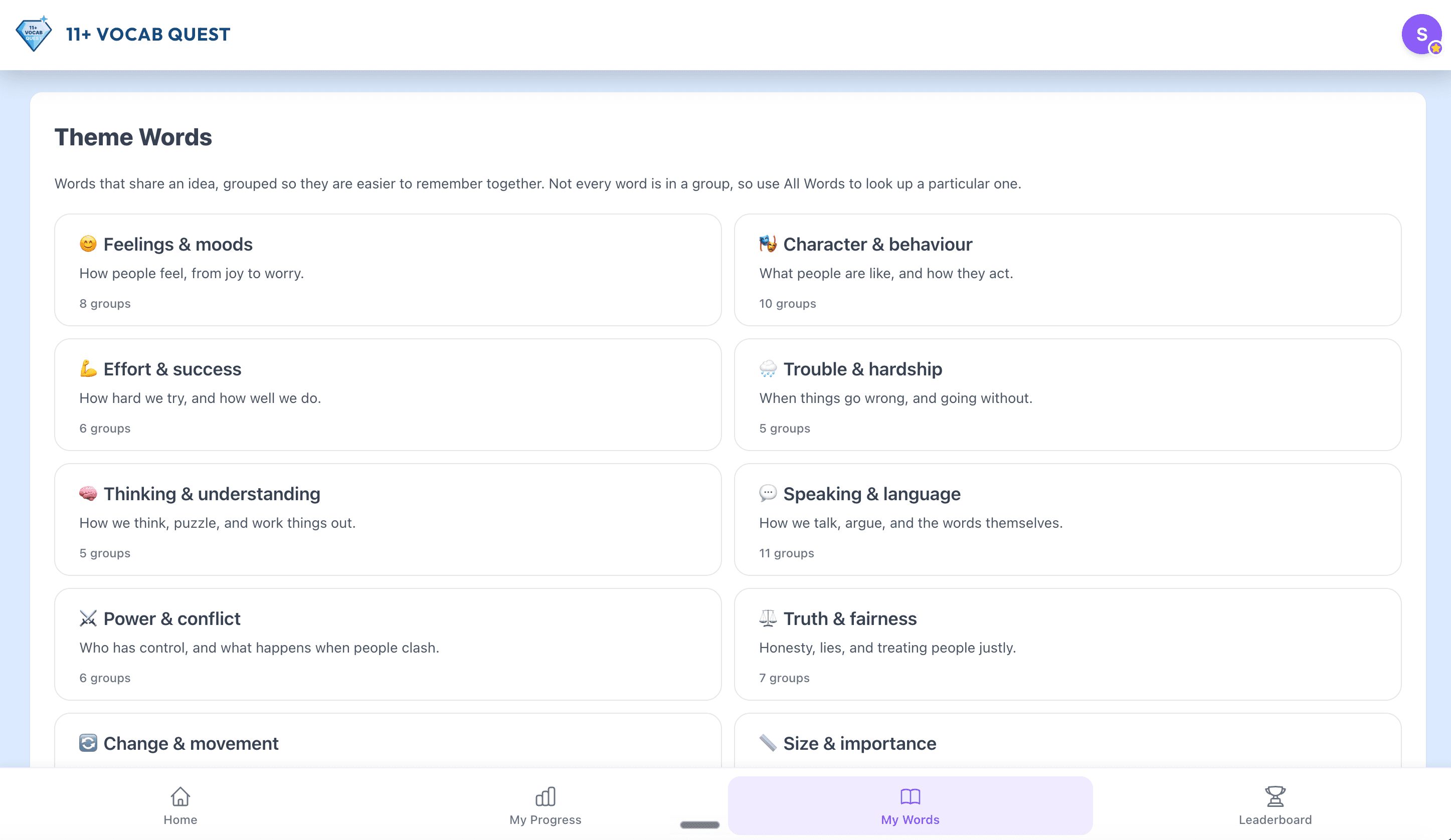
11+ Vocab Quest applies exactly this thematic structure to its full bank of 1,800+ curated 11+ vocabulary words, organising them into categories such as Feelings and Moods, Character and Behaviour, Thinking and Understanding, Speaking and Language, Power and Conflict, and Places and Nature, accessible from My Words > Theme Words.
Within My Words > Theme Words, clicking into any word opens a flashcard-style view showing its definition, synonym, antonym and a usage example, the same branches a hand-drawn mind map would build manually. Where a word needs more than that quick view, adding it to the active learning queue puts it through all six question types in turn, meaning, synonym, antonym, fill-in-the-blank, context and usage, rather than marking it done after a single definition check. That range matters because a child who can only recite a definition has not yet shown they can recognise the word in context, use it correctly in a sentence, or spot its opposite under timed conditions, and any one of those can appear on an exam paper.
Explore the Theme Words feature in 11+ Vocab Quest to see these categories in action, free to try.
Frequently Asked Questions
Is it better to learn 11+ vocabulary by theme or alphabetically? Thematically. An alphabetical or randomly ordered list gives words no meaningful connection to each other, so each one has to be remembered independently. A themed list connects words to a shared scenario, which research on second-language vocabulary learning associates with stronger long-term retention than unconnected or purely synonym-based lists.
How many theme words should my child learn per week? Around 10 to 15 words per theme is a realistic weekly target for most 11+ candidates. That is enough to build a genuine mind map with synonyms, antonyms and usage examples for each word, without overloading a single week, and it leaves time within the week to test the words from more than one angle before moving on.
Do theme words help with the 11+ synonym and antonym questions specifically? Yes, directly. Because a themed set already groups words that share or contrast in meaning within a scene, a child practising a theme is simultaneously practising the synonym and antonym recognition that verbal reasoning papers test. The mind map method builds a synonym and antonym branch into every theme by design.
Can thematic learning work alongside flash cards? Yes. Flash cards are a useful format for repeated retrieval practice; the issue is not the format but how the words on them are grouped. Organise the cards by theme rather than alphabetically or at random, and the same cards benefit from the retention advantage that thematic grouping provides.