
What Vocabulary Should You Review in the Final Month Before the 11+ Exam?
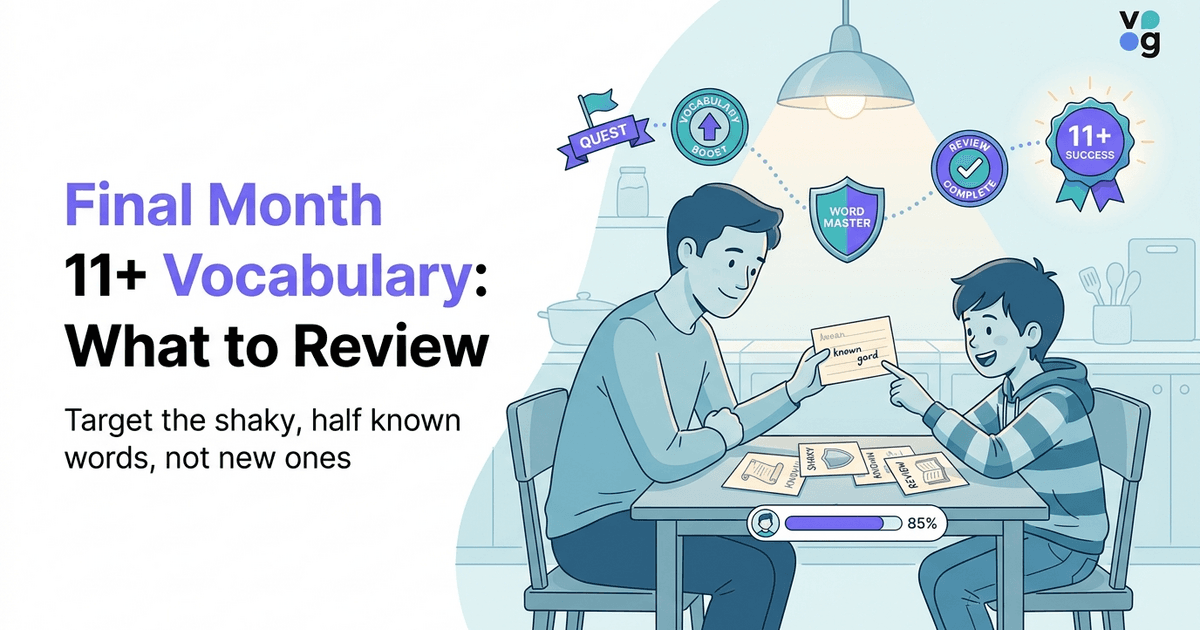
In the final month before the 11+ exam, revision time works best when it targets vocabulary your child already half knows rather than brand new words met for the first time. New words have not had enough repeated exposure to reach reliable recall under exam pressure, whereas words your child recognises but still gets wrong are exactly the ones that spaced review can lock in fast. Build a short, rotating priority list of these shaky words and test each one from several angles, meaning, synonym, antonym, and context, so gaps in understanding surface before exam day rather than during it.
Key takeaways
New vocabulary introduced in the final four weeks rarely reaches confident recall in time for the exam; consolidating known-but-shaky words is the higher-value use of that time.
A word your child gets wrong more than once in practice belongs on a priority list; a word tested once and passed does not need more revision time.
Testing a word only by asking for its definition hides gaps in synonym, antonym, and context recognition; testing from several angles surfaces the real gap.
Fifteen to twenty minutes of focused daily review, rotating a short priority list, retains better than occasional long sessions.
Producing a priority word correctly in a sentence or conversation is a stronger sign of readiness than recognising it on a flashcard.
Should You Learn New 11+ Vocabulary Words in the Final Month, or Revise Known Ones?
In the final month, your child's revision time is better spent reviewing words they have already met than learning brand new ones. Word learning is not instant: a new word typically needs several spaced exposures before it moves into reliable, exam-ready recall. Introduce it for the first time three or four weeks out and there is a real risk it is still shaky, or forgotten altogether, on exam day.
Spaced retrieval is the practice of testing a word again after a gap, rather than restudying it immediately, so the brain has to work to bring it back. A 2021 study in the Journal of Neurodevelopmental Disorders found that children who practised words through repeated spaced retrieval recalled more of them than children who simply restudied the same words, and the benefit held for children with typical language development, not only those with language difficulties. The final month of 11+ preparation is exactly the window for this: enough time remains for two or three spaced retrieval passes on a half-known word, but not enough for a brand new word to complete that same cycle and land securely.
A word your child gets wrong more than once in practice matters more, this month, than ten new words met for the first time this week.
Which 11+ Vocabulary Words Deserve Your Remaining Revision Time?
The words that deserve your remaining revision time are the ones your child recognises but still gets wrong, not the ones they have never seen and not the ones they already know cold. A half-known word is one your child can partly define, or defines correctly sometimes and incorrectly other times, and both it and a word missed more than once in practice belong on the priority list. A confidently known word, tested correctly two or three times running, can drop off it.
Word status
Final-month priority
Why
Brand new, never met
Low
Not enough time left for repeated spaced exposure to reach reliable recall
Recognised but shaky
High
Spaced retrieval consolidates it quickly at this stage
Confidently known
Minimal
Further review here has a low return on your child's limited time
Building a priority list of tricky words
Keep this list short and rotating rather than fixed: add a word to it the moment your child gets it wrong, and let review time draw from that shifting list instead of a static worksheet. Do not add new vocabulary to the list during this period; it should only ever grow from words your child has already met and found tricky. 11+ Vocab Quest can manage a list like this automatically, covered below.
How Do You Find Out Which Words Your Child Is Actually Struggling With?
You find out which words your child is actually struggling with by testing each one from more than one angle, not just asking for its definition. A skill gap is a specific format, synonym, antonym, or context, where recall breaks down even though the word's meaning is known, and a single "what does this word mean" drill hides it completely.
Testing a word across several formats, meaning, synonym, antonym, fill in the blank, context, and usage, surfaces exactly which specific skill is weak, rather than a single pass or fail verdict.
How Do You Turn Review Words Into Daily Discussion and Writing, Not Just Flashcards?
You turn review words into stronger, exam-ready knowledge by using them in your child's own writing and in everyday conversation, not only on flashcards. Active recall is retrieving a word from memory unprompted rather than merely recognising it when shown, and producing a word correctly in an original sentence your child constructs is a more demanding, more reliable test of readiness than a flashcard offers.
Work priority words into family conversation during the final month, asking your child to use one in a sentence about their day, and encourage them to reach for the same words in their schoolwork and everyday writing. 11+ Vocabulary Learning Techniques sets out more ways to help a word stick for the long term, beyond this final-month window.
What Does a Realistic Final-Month Vocabulary Schedule Look Like?
A realistic final-month vocabulary schedule is fifteen to twenty minutes of focused daily review, rotating a short priority list rather than expanding it. Short, familiar routines are easier to sustain for four straight weeks than occasional long sessions, and they reduce the burnout risk that comes with a rushed, last-minute push before an exam. If your child is earlier than the final month in their overall preparation, the right balance of new learning versus review depends on how much time is left before the exam, not just on the final-month rule covered here. Daily Vocabulary Practice for 11+: How Much Is Actually Enough? breaks this down by stage of preparation.
Keep the session predictable: a quick pass through the priority list, then fold any newly discovered tricky words into tomorrow's list.
How Does 11+ Vocab Quest Help With Final-Month Revision?
11+ Vocab Quest is built for exactly this kind of final-month review. Add a word to your child's priority queue, like adding a track to a playlist, and it comes back into rotation automatically rather than you managing a list by hand. Each queued word is then tested through six rounds, meaning, synonym, antonym, fill in the blank, correct usage, and contextual usage, so the six-angle testing described above happens by default.
The platform also keeps a running tricky words list of everything your child has answered wrong in practice. Add those words straight to the priority queue and they come back for review automatically, instead of you tracking and rotating them by hand.
Add your child's tricky words to a priority queue in 11+ Vocab Quest and let the six round review bring them into daily practice automatically.
Frequently Asked Questions
Should I add any new words in the final month before the 11+ exam? Generally no. New words introduced this late rarely get enough repeated exposure to reach reliable recall by exam day. Your remaining time returns more value spent consolidating words your child already half knows.
How many vocabulary words should my child review daily in the final month? There is no fixed number that suits every child; the format matters more. Fifteen to twenty minutes of focused daily review, drawing from a rotating priority list, works better than one long weekly session covering a large batch at once.
What if my child keeps forgetting the same words? A word that keeps coming back wrong is telling you something useful: it needs a different kind of practice, not just repetition of the same drill. Test it from a different angle, synonym or context instead of definition, and ask your child to use it in their own sentence so recall becomes active rather than passive.