
11+ Exam Day: What to Expect and How to Prepare (2026 Guide)
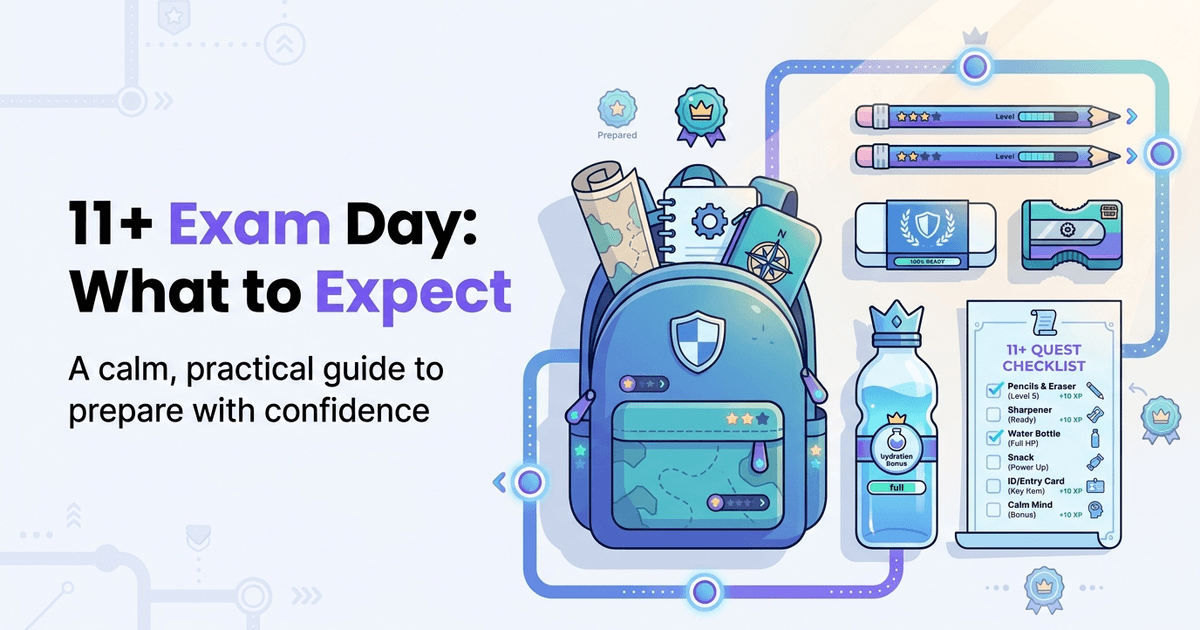
Here is what to expect on 11+ exam day: your child arrives 30 to 45 minutes before the start time, says a short goodbye, sits two timed papers of roughly 45 to 60 minutes each with a break between them, then comes out tired and a bit vague, which is completely normal. The exact date depends on where you live: Kent primary school pupils sit the Kent Test on Thursday 10 September 2026, Buckinghamshire runs a two part Secondary Transfer Test on 8 and 10 September 2026, Redbridge tests on Friday 18 September 2026, and Barnet's two grammar schools test across September and October 2026. The final fortnight matters more for sleep, routine, and calm than for extra practice papers, and a short daily vocabulary review is one of the few things that can still move the needle this late.
Key takeaways
Regional 11+ test dates vary by council and school: Kent (10 September 2026), Buckinghamshire (8 and 10 September 2026), Redbridge (18 September 2026), Barnet's Queen Elizabeth's School (16 or 17 September 2026) and Henrietta Barnett School (early September, with a second round in early October 2026), and the ISEB Common Pre-Test for independent schools (any time from 1 September 2026, set by the senior school).
Pack the exam bag together the night before: candidate letter, two black pens or HB pencils plus a spare, an eraser, a sharpener, a clear water bottle, and a permitted watch. Calculators, phones, and smartwatches are banned everywhere.
In the final two weeks, cut back rather than intensify: one or two timed papers for pacing, short 20 to 30 minute sessions in the last week, nothing at all the day before, and protected sleep every night.
Nerves are not the problem; fear of the nerves is. A rehearsed breathing technique and a mid-paper reset ritual give your child something concrete to do when panic hits.
National Offer Day, when families learn which secondary school has made an offer, falls on 1 March 2027 for this year's cohort.
When Is 11+ Exam Day in 2026?
Most state grammar schools in England test in the first two to three weeks of September, at the very start of Year 6. A smaller group, mostly in London, tests later into October, and independent schools run on a separate, more flexible calendar entirely.
The 11+ is administered locally, so the exact date is set by your council or the individual school, not by a single national timetable. Confirm your own child's date directly with their school or council rather than relying on a generic list.
Area
2026 test date(s)
Format
Kent (Kent Test)
Thursday 10 September 2026 for Kent primary schools; weekend of 12 to 13 September 2026 for out of county and home educated children
One test day, sat at the child's own school or a designated centre
Buckinghamshire (Secondary Transfer Test)
8 and 10 September 2026
Two part process: a practice test followed by the graded transfer test
Redbridge
Friday 18 September 2026
Single test day
Barnet, Queen Elizabeth's School (QE Boys)
Wednesday 16 or Thursday 17 September 2026
Own entrance test, registration closes 8 July 2026
Barnet, The Henrietta Barnett School (girls)
First round in early September 2026; second round for the top ranked candidates in early October 2026
Two round selective process
Independent schools (ISEB Common Pre-Test)
Any date from 1 September 2026 through late May 2027, chosen by each senior school
Sat once per academic year, often at the child's own prep school
Results are typically released in mid October across most state grammar areas. National Offer Day, when every Year 6 family learns which secondary school has offered a place, is 1 March 2027 for children applying this admissions round.
Sources: Kent County Council, Kent Test registration, Buckinghamshire Council, Secondary Transfer Test dates, Redbridge Council, Redbridge 11+, Queen Elizabeth's School, admissions, The Henrietta Barnett School, admissions, ISEB, Common Pre-Tests for families, Buckinghamshire Council, National Offer Day.
What Should My Child Bring on the Day?
Most schools send a letter specifying exactly what is required, and that letter overrides any general list. As a starting point, pack:
The admission or candidate letter (some schools also ask for photo confirmation)
Two black pens or HB pencils, plus a spare of each
An eraser and a pencil sharpener
A clear water bottle
A watch, if your child can read one, checked in advance against the school's rules
Calculators are almost never allowed in an 11+ paper. Neither are phones, smartwatches, or pencil cases with printing on them, since anything that could be mistaken for notes is typically banned.
Pack the bag together with your child the night before, not for them. It hands them a small, concrete sense of control over a day where they otherwise have very little.
What Actually Happens on 11+ Exam Day?
Knowing the shape of the morning removes a surprising amount of anxiety, for both of you.
Arrival and registration
Most schools ask candidates to arrive 30 to 45 minutes before the start time. Children usually wait in a holding area, a hall or sports hall, where they are registered and given a candidate number.
Saying goodbye
Parents say goodbye at the door, and this is often the hardest moment of the day for the adult, not the child. Keep it short and light. A long, emotional goodbye signals that this is a moment worth being frightened of, and children pick up on that instantly.
The papers
Formats differ by region, but most children sit two papers with a short break between them. Each paper typically runs 45 to 60 minutes and covers some mix of English, maths, verbal reasoning, and non-verbal reasoning depending on the test provider. There is usually a familiarisation section, or practice questions read aloud, before the timed section starts.
Finishing and collection
Children come out in waves rather than all at once. Expect a wait, and expect your child to look tired and slightly vague when they emerge. That is the normal, expected state after ninety minutes of sustained concentration, not a sign that anything went wrong.
What Should We Do in the Final Two Weeks?
Less than instinct suggests. The urge to intensify, with more papers, longer sessions, one last push, almost always backfires. Two weeks is not enough time to learn anything substantially new, but it is more than enough to exhaust a ten year old.
A more realistic final fortnight looks like this:
Weeks out from the exam: one timed full paper, at most two. The purpose is pacing and stamina, not new content. Mark it together and look for patterns across mistakes rather than correcting each one individually.
Final week: short, light sessions of 20 to 30 minutes. Review vocabulary, and revisit the one or two question types your child still finds fiddly. Stop entirely by the Thursday if the exam falls on a Saturday.
The day before: no papers at all. Do something unrelated, a walk, a film, a swim, and use the time instead to sort the bag and confirm the route.
A well rested child working from 90 percent of their knowledge will consistently out-score an exhausted one sitting at 100 percent.
Protecting sleep is the single highest value action available in the final week, and it costs nothing to implement.
Vocabulary is one of the few areas where a small amount of last minute, structured review still pays off. A word learned this week can genuinely appear on next week's paper, in a way that a new maths technique rarely will. This is a good moment to prioritise, not to add more: focus a short daily session on the words most likely to come up, rather than working through an entire word list from the start. For a fuller breakdown of which vocabulary words to prioritise in the final month, it helps to work backwards from exam day rather than forwards from week one, and a structured preparation timeline built around your child's starting point makes that prioritisation easier to plan.
Make the last fortnight of vocabulary revision count with 11+ Vocab Quest structured word sets and spaced repetition review, so your child reviews what is actually likely to come up.
How Do I Help With Exam Nerves?
Nerves are not the enemy. A degree of adrenaline sharpens focus. What actually harms performance is fear of the nerves themselves, the spiral that starts when a child notices their heart racing and reads it as a warning sign rather than ordinary readiness.
Reframe it before the day arrives: the fluttery feeling in the stomach is the body getting ready, not a sign that something is wrong. Three things genuinely help in the run up:
Practise the breathing. Three slow breaths, exhaling for longer than the inhale, before the paper is turned over. Rehearsing it a few times in the week beforehand makes it automatic rather than something to remember under pressure.
Give them a reset ritual. If panic hits mid paper, the plan is simple: pencil down, three breaths, back in. Knowing there is a plan makes the panic itself less frightening.
Watch your own language. Children read parental anxiety with striking accuracy. "This will decide everything" lands very differently from "let's see how it goes," even when both are said with the best intentions.
What Should I Say in the Car on the Way?
Keep the conversation ordinary. Music, football, what is for dinner afterwards, anything other than the exam itself, gives your child's mind somewhere else to sit for the last twenty minutes.
If your child raises the exam unprompted, a few lines are worth having ready: "You know more than you think you do," "if a question is hard, it is hard for everyone," and a small concrete plan for afterwards, whatever that looks like in your family.
Afterwards, resist reconstructing the paper question by question. It changes nothing about the outcome and can turn a solid performance into a source of dread. "How was it?" is enough. If your child wants to talk it through, they will.
Five Exam Strategies to Share With Your Child
These five habits convert existing knowledge into marks more reliably than any last minute content review.
Strategy
Why it works
Read the question twice
Most lost marks come from answering a slightly different question than the one actually asked
Do not get stuck
Thirty seconds, then mark it and move on; a hard question is worth exactly the same as an easy one
Never leave a blank
Nothing is deducted for a wrong answer, so an empty box is a guaranteed zero
Break unfamiliar words apart
Prefixes, roots, and the surrounding sentence usually narrow an unknown word down
Check the answer sheet lines up
On a separate answer grid, one skipped row can wreck an entire section; glance at the numbering every few questions
A Short Letter for Your Child
Print this, or read it aloud the night before.
Dear [Child's Name], you have got this. You have done the practice papers and put in the work. Whatever happens on the day, that work is already yours to keep.
Read the question twice. Most lost marks are not about not knowing, they are about answering a slightly different question than the one asked. If a question will not budge after thirty seconds, mark it, move on, and come back later. Guess rather than leave a blank; no marks are taken away for a wrong answer. When you do not know a word, look at the parts of it, the prefix, the root, the sentence around it.
Breathe before you start. Three slow breaths. The nerves are just your body getting ready, and they are on your side.
This test measures one morning, not you. Good luck. Go show them what you know.
Frequently Asked Questions
When do 11+ results come out, and when is National Offer Day?Most state grammar school results arrive in mid October, though the exact date varies by council. National Offer Day, when every Year 6 family finds out which secondary school has made an offer, is 1 March 2027 for this year's applicants.
What happens if my child is unwell on exam day?Contact the school or council administering the test as early as possible on the morning of the exam. Most areas set aside a reserve test date or a special consideration process for illness, but this needs to be raised on the day, not afterwards, so keep the relevant phone number to hand alongside the candidate letter.
Are calculators or smartwatches allowed in the 11+ exam?No. Calculators are banned in almost every 11+ paper, and smartwatches are banned everywhere, along with phones and pencil cases with printing on them. A plain analogue or digital watch is usually permitted, but check the specific school or council's rules in advance since requirements vary.
How much does last minute vocabulary revision actually help?More than most other last minute revision, because vocabulary is one of the few areas where new learning in the final fortnight can genuinely show up on the paper. According to 11+ Vocab Quest data, the platform's curated bank of 1,800+ 11+ specific words is built to be prioritised rather than worked through in order, so a child can spend twenty minutes a day on the words most likely to appear instead of revising an entire list from the start, which tends to be a more realistic use of the time that is left.
Disclaimer
This guide is based on publicly available information about the 2026 11+ exam season, current at the time of writing. Exam dates, permitted items, registration deadlines, and procedures are set independently by each council, school, or awarding body and can change without notice. Treat everything here as a starting point, not a final word: always verify the specific details for your child's exam directly with their school or local council admissions team, and do not rely solely on this article when making preparation or logistics decisions.